


We know you’re getting pulled in two directions right now. Everyone’s talking about AI like it’s the magic bullet for business growth, while cybersecurity experts are practically screaming about ransomware attacks. You’ve got limited time, limited budget, and you need to make the right call.
Here’s the straight answer: Cybersecurity comes first. Every single time.
This isn’t about being scared of innovation or playing it too safe. It’s about building a foundation that actually lets you innovate without losing everything you’ve worked for.
The Reality Check Most Small Firms Need to Hear
The numbers don’t lie: and they’re getting worse. Between 43-60% of all cyberattacks now target small and medium businesses. That’s not some distant threat happening to other people. That’s your competitors, your vendors, maybe even your clients.
Here’s what really stops people in their tracks: 60% of small businesses shut down within six months of a major cyber incident. Not struggle for a while. Not bounce back slowly. They close their doors permanently.

But here’s where it gets personal. Your biggest potential clients won’t even consider working with you if you can’t demonstrate proper cybersecurity measures. Supply chain security requirements have become as basic as having liability insurance. Without them, you’re automatically disqualified from the contracts that could transform your business.
The financial reality is stark. While nearly half of small businesses spend less than $1,500 per month on cybersecurity, the cost of a single breach can run into hundreds of thousands of dollars. We’re talking about reputational damage that takes years to repair, customer loss that may never recover, and operational downtime that can kill momentum permanently.
Why AI Actually Makes Cybersecurity More Urgent (Not Less)
Here’s the twist nobody saw coming: AI isn’t just a business opportunity. It’s also the biggest threat multiplier we’ve seen in decades.
Criminals are using AI to scale attacks faster than ever. They’re creating AI-generated phishing messages that slip past traditional email filters, automating targeting to find your weakest points, and building attacks that adapt in real-time. Traditional antivirus software now stops less than 50% of advanced threats.
Even scarier? Zero-click attacks: where criminals don’t need you to click anything or make any mistakes: are becoming routine. The game has changed completely.
81% of small and medium businesses already recognize that AI increases the need for additional security controls. They’re not wrong. The old playbook of “don’t click suspicious links and use strong passwords” isn’t nearly enough anymore.

The Sequential Approach That Actually Works
Smart firms aren’t choosing between security and innovation: they’re using security as the foundation for sustainable innovation. Think of it like building a house. You can’t put up beautiful walls on a cracked foundation and expect them to stay standing.
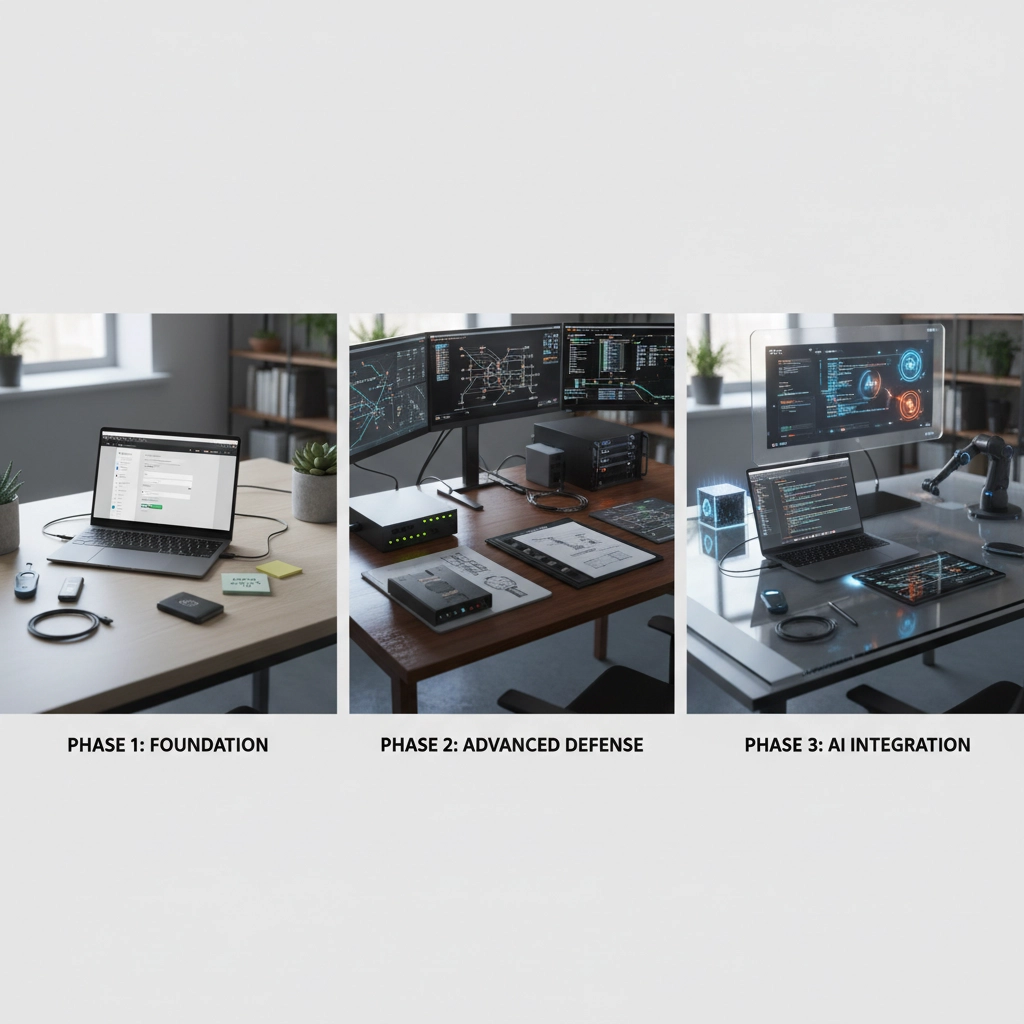
Phase 1: Security Foundation
Start with the basics that protect you right now:
- Enable multi-factor authentication on every critical account
- Implement a business-grade password manager for your entire team
- Conduct a basic risk assessment to understand what you’re protecting
- Establish automated backup procedures that actually work
- Begin employee security awareness training
Nothing fancy here. These are the fundamentals that stop 80% of common attacks.
Phase 2: Operational Security
Once the basics are locked down:
- Implement cloud security controls and vendor risk management
- Secure remote workers with VPNs and proper device configurations
- Build comprehensive endpoint protection across all devices
- Create incident response procedures so you know what to do if something goes wrong
Phase 3: Strategic Integration
Only after your foundation is solid:
- Evaluate AI-powered security tools that enhance your existing defenses
- Selectively implement AI business applications with proper security controls
- Use AI for threat detection, anomaly detection, and automated response
When AI Can Safely Enter the Picture
The good news? Once you have solid cybersecurity fundamentals, AI can actually make your security better, not worse. AI-powered threat detection can spot patterns human analysts miss. Automated response systems can shut down attacks in seconds instead of hours.
AI becomes your security ally when:
- Your basic security hygiene is already strong
- You have proper access controls and monitoring in place
- Your team understands security best practices
- You’ve tested your incident response procedures
Red flags that show you’re not ready for AI yet:
- People are still using personal email for business
- You don’t have regular backups or haven’t tested restoring them
- Multi-factor authentication isn’t enabled on critical systems
- You can’t account for all the devices accessing your network
The Competitive Advantage You’re Missing
Here’s what successful firms have figured out: Strong cybersecurity isn’t just protection: it’s a competitive advantage that opens doors AI innovation alone never could.
When you can demonstrate robust security practices:
- You win contracts competitors can’t even bid on
- Your insurance premiums stay manageable
- Customers trust you with sensitive information
- You can actually innovate without constantly looking over your shoulder

The businesses thriving in 2025 aren’t the ones with the flashiest AI tools. They’re the ones that built security-first cultures, then strategically layered in innovation on top of that foundation.
Your Practical Next Steps (No Shame in Starting Small)
If you’re starting from scratch, focus entirely on Phase 1 security basics for the next 30 days. Skip the AI conversations until you can confidently say your fundamentals are solid.
If you have basic security covered, move into Phase 2 operational security while researching AI applications. Don’t implement both simultaneously.
If your security foundation is strong, you can start evaluating AI tools: but security-focused AI first, business process AI second.
There’s absolutely no shame in starting where you are. The shame is in pretending you’re further along than you actually are and leaving your business vulnerable while you chase the next shiny object.
The Bottom Line
Cybersecurity isn’t the enemy of innovation: it’s the prerequisite for sustainable innovation. You can’t disrupt markets if a ransomware attack disrupts your entire operation first.
The firms that get this right will use their security strength as a foundation for AI innovation that their less-prepared competitors simply can’t match. They’ll be the ones still standing to enjoy the benefits of both.
Ready to build that foundation? Contact us to discuss your specific situation. We’ve helped dozens of small firms prioritize correctly and build security programs that enable growth instead of limiting it.