


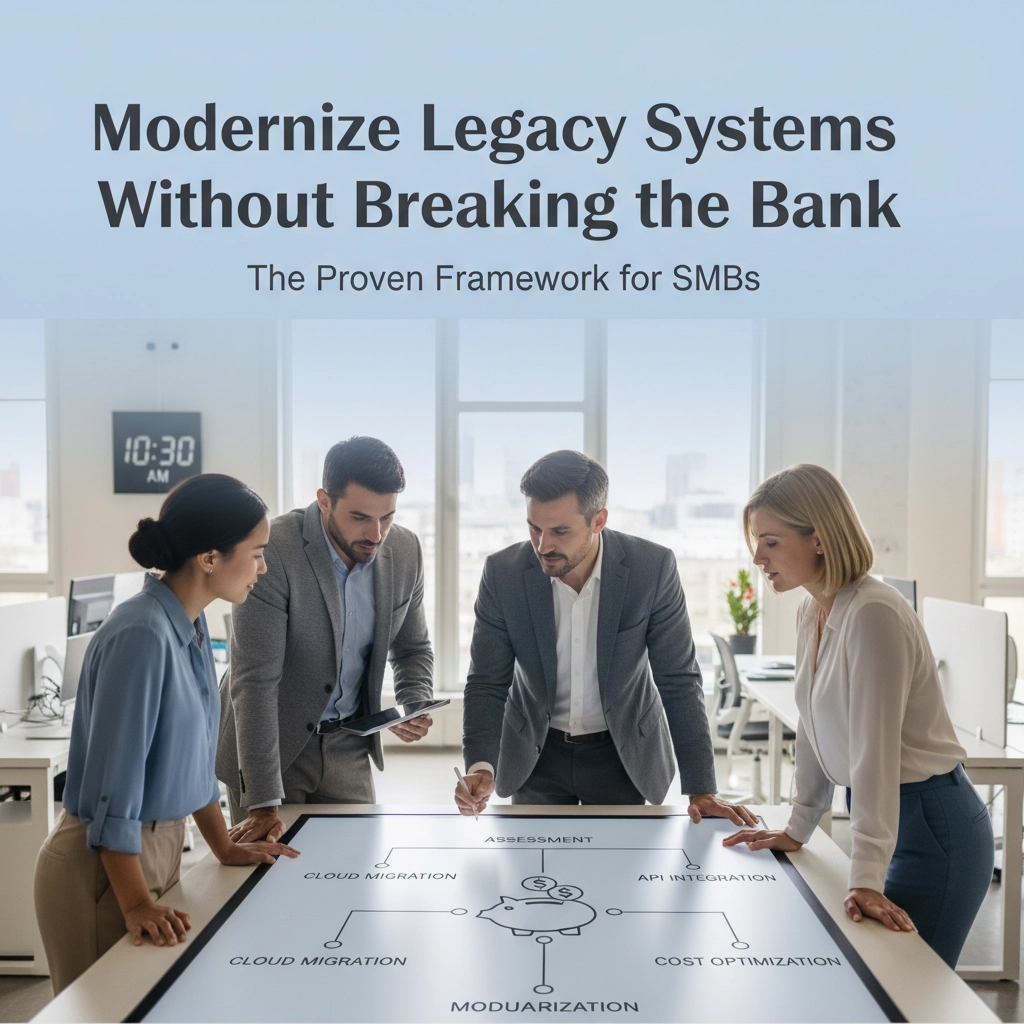
Ready to modernize but worried about costs spiraling out of control?
We know most small and medium businesses are stuck between a rock and a hard place. Your legacy systems are slowing you down, creating security risks, and eating up IT budgets: but the thought of a massive, expensive overhaul feels overwhelming.
Here’s what most organizations struggle with:
• Outdated systems that can’t keep up with business growth
• Security vulnerabilities in aging infrastructure
• High maintenance costs for legacy hardware and software
• Limited integration capabilities that create data silos
• Fear of disruption during system transitions
• Budget constraints that make enterprise solutions feel impossible
That’s where we come in. After helping dozens of SMBs successfully modernize their systems, we’ve developed a proven framework that lets you upgrade strategically without breaking the bank.
The Smart SMB Modernization Framework: Your 7-Option Roadmap
Forget the “rip and replace” mentality that enterprise consultants love to push. Smart SMBs use what we call the 7 Rs Framework: a flexible approach that lets you choose the right modernization path based on your specific budget and business needs.
Option 1: Rehosting (Lift-and-Shift)
Best for: Tight budgets, quick wins
This is your most budget-friendly starting point. Simply move your existing applications to the cloud without changing the code. You’ll immediately reduce hardware costs and gain better reliability.
Real example: A 25-person accounting firm saved $2,400/month by moving their server-based software to AWS, eliminating their on-premise server room entirely.
Option 2: Replatforming (Lift, Tweak & Shift)
Best for: Modest budgets, incremental improvements
Take rehosting one step further by making minor optimizations during the move. Think containerization or switching to managed databases.
Option 3: Refactoring
Best for: Growing businesses, long-term thinking
Modify your applications to take advantage of cloud-native features. Break down large applications into smaller, more manageable pieces.

Options 4-7: Encapsulation, Re-architecting, Rebuilding, and Replacing
Best for: Specific use cases, higher budgets
These advanced options involve wrapping legacy systems with modern interfaces, completely redesigning applications, or replacing them entirely. Most SMBs should start with options 1-3 before considering these.
The Budget-Smart Implementation Strategy
Here’s the secret sauce: Don’t try to do everything at once.
The most cost-effective approach uses phased implementation: upgrading your most critical systems first, then expanding as you see results and build confidence.
Phase 1: Assessment and Quick Wins (Month 1-2)
Start with a comprehensive audit of your current systems. We’re talking about:
- Cataloging all applications and their business value
- Identifying security vulnerabilities and compliance gaps
- Mapping system dependencies and integration points
- Calculating current maintenance and operational costs
Pro tip: Focus on systems that are costing you the most in maintenance or creating the biggest productivity bottlenecks.
Phase 2: Low-Risk Migrations (Month 3-6)
Begin with non-critical systems or those with minimal business impact. This lets your team get comfortable with new processes before tackling mission-critical applications.
Phase 3: Core System Modernization (Month 6-18)
Once you’ve proven the approach works, gradually modernize your core business systems. The savings from Phase 2 often help fund these more substantial upgrades.

Real-World Cost Savings You Can Expect
Legacy modernization isn’t just about keeping up: it’s about cutting costs. Here’s where SMBs typically see the biggest financial wins:
Infrastructure Cost Reduction
- Eliminate hardware purchases: Shift from capital expenses to predictable monthly cloud costs
- Reduce facility costs: No more server rooms, cooling, or space requirements
- Cut licensing fees: Many cloud services include software licensing in their pricing
Operational Efficiency Gains
- Automation opportunities: Replace manual, time-consuming processes
- Reduced IT overhead: Less time spent on maintenance and troubleshooting
- Improved productivity: Faster, more reliable systems mean happier employees
Case study: A 40-person manufacturing company automated their inventory management during modernization, eliminating 15 hours of weekly manual data entry: saving $18,000 annually in labor costs alone.
Risk Reduction Benefits
- Enhanced security: Modern systems with built-in security features
- Better compliance: Automated compliance reporting and monitoring
- Disaster recovery: Cloud-based backup and recovery solutions
Overcoming Common SMB Modernization Obstacles
“We don’t have the technical expertise.”
Partner with AWS-certified consultants or managed service providers during the transition. You get expert guidance without permanent overhead costs.
“We can’t afford downtime.”
Phased migration minimizes disruption. Start with non-critical systems and schedule core system upgrades during off-peak hours.
“We’re in a regulated industry.”
Cloud platforms like AWS offer comprehensive compliance resources for healthcare (HIPAA), finance, and other regulated sectors: often more robust than what you could build yourself.

Your 90-Day Action Plan
Ready to get started? Here’s your practical roadmap:
Days 1-30: Foundation Setting
- Complete system inventory and assessment
- Calculate current IT costs (hardware, software, maintenance)
- Identify 2-3 non-critical systems for initial migration
- Research cloud providers and get initial cost estimates
Days 31-60: Pilot Implementation
- Begin rehosting your least critical system
- Set up basic monitoring and backup procedures
- Train your team on new cloud management tools
- Document lessons learned and refine processes
Days 61-90: Expansion Planning
- Evaluate pilot results and cost savings
- Plan next phase of migrations based on business priority
- Develop timeline and budget for core system modernization
- Consider bringing in specialist help for complex applications
The Bottom Line: Modernization as Investment, Not Expense
Smart modernization pays for itself. The key is approaching it strategically rather than reactively. By starting with low-risk, high-impact changes and building momentum, you can modernize your entire infrastructure over 12-24 months without breaking your budget.
Most SMBs find that savings from their first few modernization projects help fund the more substantial upgrades that follow. It’s not about spending more money: it’s about spending money more strategically.
Want help creating your specific modernization roadmap? Every business is different, and the right approach depends on your unique systems, budget, and growth plans. Reach out to our team for a free assessment: we’ll help you identify the quickest wins and most cost-effective modernization path for your business.
The question isn’t whether you can afford to modernize. It’s whether you can afford not to.